A Harrison Ford Filmography-Top Five List

H Ford pixAmerican Graffiti-Bob Falfa-1973. Ford has a small role in this film. This was an important breakthrough film for Harrison Ford , as it brought him to the attention of George Lucas: Before the hype surrounding Star Wars, there was this small part in the coming of age movie that stands the test of time well without seeming too dated. It was a nostalgic look at a bygone era, and is still effective as a nostalgic look back almost forty years later!

Bladerunner:Rick Deckard-1982-Harrison Ford was a pivotal force in creating the illusory and remarkable world contained in Bladerunner. He portrayed a man who doesn’t seem to care anymore, and his revelation through pain and redemption-the theme that guides the film-what is real/what is the definition of a human?….is explored and continues to haunt us partly because of his performance. Ford was very involved in developing the character of Deckard, particularly when we find that he didn’t want to wear the hat (a la Indiana Jones), but instead chose to fashion a short, cropped haircut that conveys the angst and almost dark and prison-like air that surrounds this set. He also insisted that Darryl Hannah stick her fingers in his nose during the pivotal fight scene, and the graphic reality brings the physical fight home to us in a way that nothing else could in this instance.

The Frisco Kid-1979.This is a gem-one of those films that got away. Gene Wilder is hilarious as a Jewish rabbi who teams up with an unlikely partner, a cowboy/robber played by Ford. They end up in an Indian encampment, where Wilder shouts, “Watch that lady!…I think that lady is a Jewish Indian!”.as Ford watches him in mild bemusement. Somehow the plot moves them into a monastery where the effusive Wilder is hard-pressed to abide by the laws of silence governing a monastery. This unlikely duo makes for a very different kind of buddy comedy. Ford proves himself to be extremely charming in this light comic role.

Witness:1985-Detective Captin John Book- One of the staples surrounding long-term leading man success in Hollywood is the actor’s ability to convince audiences he is that character. In this part, the essence of a straight-forward cop who will not swerve from the path of justice is tailor-made for the slightly grumpy Ford persona. The nature of the love story between the Amish girl and the cynical, big-city cop makes for an enduring film.

Working Girl: 1988-Jack Trainer-Ford has a chance, once again, to show us his vulnerable, funny side. He is charming with Melanie Griffith in this still funny comedy from Director Mike Nichols.

Indiana Jones and the Search for the Holy Grail: These films got better over time. They seemed to sputter at first, with nothing surrounding the character but a sweeping theme song and a “fly by the seat of our pants” attitude towards plot. But, in the end, this character endures in part, not only because of the enthusiastic direction of Spielberg,but also the persona of Ford. He becomes Indiana Jones and embraces the role in a way no-one else could touch, as so many great actors have been able to inhabit their signature characters for all time. ( Some examples that come to mind: Marlon Brando in A Streetcar Named Desire, Jimmy Stewart as Harvey, Humphrey Bogart in The African Queen, Tom Hanks in Forrest Gump). With the addition of his father, played by Sean Connery, this makes for a great twist on the buddy pictures of years past.
About The Great Gatsby…”Do I Have to?”

 The Great Gatsby has been made into a movie. Again. For the fifth time. I remember the last time they made this film as a big budget production back in the seventies. That filmed version featured Robert Redford as Gatsby. This one has Leonardo DiCaprio. Both of these men are great actors. But the problem might be that the material remains the same.

Can it be that one of the quintessential books of the twentieth century, one of the Great American Novels, is just not good movie material? That’s what I’m thinking….

 Here are  the two closing paragraphs from Fitzgerald’s book, “The Great Gatsby”

 “Gatsby believed in the green light, the orgiastic future that year by year recedes before us. It eluded us then, but that’s no matter-tomorrow we will run faster, stretch out our arms farther…And one fine morning-

 So we beat on, boats against the current, borne back ceaselessly into the past.”

 In the short story, The Rich Boy, Fitzgerald expands upon this theme of the rich as careless and consciously embracing class warfare with this famous passage: (It contains the sentence which his biographer, Bruccoli, calls Fitzgerald’s “most promiscuously misquoted sentence”:

“Let me tell you about the very rich. They are different from you and me. They possess and enjoy early, and it does something to them, makes them soft where we are hard, and cynical where we are trustful, in a way that, unless you were born rich, it is very difficult to understand. They think, deep in their hearts, that they are better than we are because we had to discover the compensations and refuges of life for ourselves”

 The two stories, The Great Gatsby and The Rich Boy, both deal with the careless rich; those who have plenty.  Fitzgerald manages to hold up a ruthlessly accurate looking glass to the lives and psyche of the very rich. A quote from Fitzgerald himself says it all,  “I have never been able to forgive the rich for being rich…”

 Sadly, one of the take-aways from the life of Fitzgerald may be that he himself was the ultimate model for Gatsby. The character of Gatsby met a tragic end and died in obscurity. The Golden Girl that was Daisy was shown to be little more than a callous and shallow object of desire, unworthy of such intense devotion.

In reality, Zelda Fitzgerald, a lionized symbol of the age of flappers and the newly-emancipated woman, died in a fire after enduring years of treatment for mental illness. And Fitzgerald died in Hollywood, an alcoholic who was living in relative obscurity after being feted as one of the golden darlings of the Jazz Age and the Modern Era of Literature .

 As stated earlier, Gatsby has been filmed before. This will be the fifth film, the first one starting out as a silent picture. Zelda said of that first movie: “It’s rotten and awful and terrible and we left. (Hollywood).”  In the seventies I recall also that the big budget spectacle with Redford and Mia Farrow was panned as a fairly rotten and awful disaster. This time around, again some of Hollywood’s elite players have gathered together to tell this simple story that defies the cinematic art form.

 Could it be that the Great American Novel was never meant to become the Great American Film? I believe the honorary title of “Great American Film” goes to “The Godfather”. The original Godfather, or to be precise the trio of films surrounding Coppola’s masterpiece, gets to the heart of the American Dream far faster and much more effectively than does this beautifully written novel.

 Fitzgerald is telling a tragic tale about the limits and capacities of the American Dream. In The Godfather, there is no moral compass and no limits beyond the immediate family. Gatsby kept a list of resolves as a young man that serves to illustrate his transformation. In The Godfather, the head of the Corleone family simply puts forth offers that no-one can refuse. Both men, Gatsby and Corleone, operate outside the law. Both are bootleggers and lawbreakers. In Gatsby’s world, there is an unspoken code that doesn’t allow vulgar new money to infiltrate the ranks. In The Godfather, the family unit is the only boundary that is found to be worthy of protection.  Michael Corleone shields his wife and children when the bullets infiltrate the walls of his home. With Gatsby’s death, the violence is swept under the carpet and he is simply brushed aside.

 In Gatsby’s world, there is the green light. In The Godfather, the light has been shattered. We identify with those who fashion their own destinies in The Godfather. Much as Lawrence of Arabia glowingly decreed a decade earlier. “Nothing is written” and as Americans, we know we must shape our destiny. This was the theme of The Godfather. In The Great Gatsby, the will is crushed, the memory is swept away and there is no justice or retribution. We are left as helpless bystanders without hope.  With Gatsby, there is not the overwhelming feeling of power shown on screen in which we feel this new immigrants (the Corleone’s) need to shape destiny. That is not found in the film or in the book version of The Great Gatsby.(Gatsby is not a new immigrant, but he is infiltrating a different class)

Fitzgerald had it about right when he spoke of the rich. In the same sense, we have seen the abuses of power and money that have taken its toll on our society in the last decade. However, the films that endure are the ones that suggest hope, or at the very least, they project hopelessness in a manner we relate to as Americans and/or as a cog in the wheel of society, i.e., the middle class.

In Gatsby, we see a world of privilege, a glimpse of helplessness and a wave of despair. There is no “there” there for us. That may be the biggest problem. No matter what, it always turns out the same. The green light still shines brightly for no apparent reason. We need a reason to believe in the green light.

Fitzgerald in Hollywood: The Great Gatsby-an excerpt from the upcoming book, “6 Degrees of Film”

From the upcoming book “6 Degrees of Film” by M.L. Johnson
F. Scott Fitzgerald, as with all great writers in Hollywood, was part myth and part reality. He tried his luck several times in California, accompanied on his first trip by his equally colorful wife Zelda. Their attitude was condescending, to say the least, as Fitzgerald wrote, “I honestly believed that with no effort on my part I was a sort of magician with words.” Fitzgerald said he felt he “was doing Hollywood a favor.” Their tenure was short and ended badly, with Zelda writing of the film adaptation of The Great Gatsby, “It’s rotten and awful and terrible and we left.”
On his second trip, Fitzgerald embarrassed himself at a party held by famed producer Irving Thalberg. Thereafter, Fitzgerald sought the ever-confident Thalberg’s approval. His need “to conquer Thalberg, to make the man recognize their essential kinship, was mysterious and powerful enough to override even the most contemptuous rebuffs.” All in all, Fitzgerald made three trips to Hollywood. During the third, in 1940, he died from a heart attack. He was forty-four.
Fitzgerald had just about finished his career by advertising many of his greatest shortcomings in the short story The Crack Up. Fitzgerald writes in the story, “As long past as 1930, I had a hunch that the talkies would make even the best-selling novelist as archaic as silent pictures.” After this appeared, a rather devastating article was printed in the New York Post describing Fitzgerald as “jittery, restless” and a novelist “whose twitching face … bore the pitiful expression of a cruelly beaten child.”
Of Hollywood, Fitzgerald wrote, “I hate the place like poison. I should consider it only as an emergency measure.” And yet Fitzgerald was implored by his agent to return. He wrote a (surprisingly) measured, thoughtful response, saying, “No single man with a serious literary reputation has made good there” (Bruccoli XXXX, pg).
Gore Vidal wrote that Fitzgerald was “enough of an artist or romantic egotist to want to create movies.” In “Pink Triangle and Yellow Star,” Vidal wrote:
Fitzgerald thought the way to conquer Hollywood might have been to know the enemy and study their weaknesses. He had sat for hours watching all of MGM’s hit movies from the last fifteen years; [collecting] hundreds of file cards listing tricks of the trade, noting the strengths and weaknesses of individual stars, itemizing well-tried plot lines.
Fitzgerald’s third trip to Hollywood began with the attitude that this time he was determined not to mess it up. But by that time, Fitzgerald was a known entity: a drinker, difficult to work with. Nevertheless, he had a champion among the studio elites in Edwin Knopf, who hired him for a Gary Cooper picture, Three Comrades.
Joe Mankiewicz and Fitzgerald sparred throughout the writing process. Fitzgerald railed against the director’s ttampering with the ending and cutting his dialogue and scenes. Yet, when the two scripts are compared, it’s very hard to see what all the fuss was about; they were actually very similar. Fitzgerald’s dialogue, if anything, was a bit less wordy and pretentious than the script with Mankiewicz’s alterations. Still The Three Comrades was a hit when it opened in 1938, the only script for which Fitzgerald was actually given credit.
Mankiewicz said,
I personally have been attacked as if I had spat on the American flag because it happened once that I rewrote some dialogue by F. Scott Fitzgerald. But indeed, it needed it! The actors … absolutely could not read the lines. It was very literary dialogue, novelistic dialogue that lacked all the qualities required for screen dialogue. The latter must be “spoken.” F. Scott Fitzgerald wrote very bad spoken dialogue.
Fitzgerald’s Final Days
After The Three Comrades, Fitzgerald’s contract was not renewed. He wrote, “Baby, am I glad to get out! I’ve hated the place since Monkeybitch [Mankiewicz] rewrote 3 Comrades,” to Harold Ober in the book As Ever.
He had lasted eighteen months and was exhausted—emotionally and physically. He’d given it his best shot and come up short. He had given lavishly of his most valuable obsessions, namely his superior drinking-problem heroes, beautiful doomed girls, and dreams that were either squandered or destroyed.
He’d hardly touched alcohol—a major feat for him—but in the end, Fitzgerald had failed to deliver the goods. In February 1939, he went freelance, the writer’s code that indicated “desperate for work.” He also went on a drinking spree with a twenty-five-year-old named Budd Schulberg,* which was described as his biggest, saddest, and most destructive spree.
Desperate for money, Fitzgerald had hit rock bottom. (At the time of Fitzgerald’s death, none of his major novels were even in print.) Darryl Zanuck gave him a chance in 1940 on a play adaptation. But once again, Fitzgerald was taken off the picture, and this time, Nunnally Johnson was called in to doctor the script. In November of that year, at Schwab’s drugstore, Fitzgerald had a heart attack and died a month later.
“Poor son of a bitch,” was the statement Dorothy Parker made at his funeral. The irony was not lost on her that few in Hollywood knew she was quoting directly from The Great Gatsby!

A great example of the Algonquin Round Table school of Hollywood humor

• Nunnally Johnson wrote this gem to George S. Kaufman regarding the film, Letter to an Unknown Woman: “The picture is about a girl who falls in love with another of those God damned pianists … and nuzzles around him until, finally, what the hell, he gives her a bang. Next week he goes to Milano to play a concert and that’s the last she sees of him—for ten years. By then she has a nine year old boy that looks like the pianist and she is married to another fellow, no musician, but what does she do now but go for this piano player again. And to her horror, what do you think? He doesn’t remember her! Right in the middle of this nuzzling, it dawns on her that he doesn’t know who the hell she is and, frankly, doesn’t seem to care so long as she gets those clothes off in a hurry. So out into the snow she runs and that’s the way the thing straggles to its tragic conclusion.”
Johnson envisioned the sequel this way: “It’s called Collected Correspondence of an Unknown Woman and instead of one incident I have something like a dozen. In other words, the piano player knocks her up regularly every five years and never DOES recognize her. Every semi-decade around she comes again, with another new kid tagging on behind, and every time he throws her on the bed and marks up another score. Once or twice he says, “Your face certainly does look familiar to me” but that’s all. Of course, she does everything she can think of to get out of him some further recognition than that, but nothing doing. Even when she lines up eight children behind her, everyone the spitting image of him, all he says is, “Jesus Christ, have we got to have that mob around while we’re doing it?” Finally, and this is the fade out, he’s a real old bastard, can’t hardly play Chopsticks, much less cross-handed stuff, and around comes this old bag again, a dozen little illegitimates trailing along behind, and nuzzles up feebly, still hopeful but much too proud to tip him off who she is, and after some heavy preliminary work, he manages to ring the bell again, possibly for the last time in his life, and as he is leaving the house and putting his hat on, we go to a close shot of him and he shakes his head and quavers, “I don’t care what ANYBODY says, I’ve seen that broad somewhere before!” FADE OUT. (Johnson and Leventhal 1981).

Capsule Review: Argo v Lincoln

My “beef” with Argo lies with the fact that the action seems to stall midpoint in the film. Somehow, the plot point that leads Ben Affleck into Iraq should have been expanded to find someone else to go with him. If this was a documentary, then there would be no question that the narrative leads us into a fairly narrow focus. The lead CIA character is sent to remove the hostages.
But films are meant to entertain, and the second part of this film is short on entertainment value. If the John Goodman or Alan Arkin characters were allowed to contribute more than an odd moment where they are seen talking on the telephone, it might have moved the action along at a different pace.
As it is, we are immersed in the twists and turns of maneuvering people and luggage through the Iranian airport and also driving to an fro in a mini-van, but it’s not quite enough. We aren’t allowed to buy in to the characters with any kind of emotional hook.
The action occurs and you are there. But something seems to be missing.
In Lincoln, all of the trappings of a Spielberg-esque movie apply here. There is some sentimentality attached to the images of Lincoln, but more than that, the iconic pictures we have seen in the famous Civil War photographs made by Matthew Brady are depicted here with unerring accuracy. Young Tad and his father, President Lincoln, are seen looking at a book together. The pose is strikingly familiar. Tad is shown in a mock-up of a soldiers uniform, playing with his toy troops. These are the images that bring the film to life.
Sally Field also manages to craft the impossible. We see a portrait of Mrs. Lincoln that is neither overly sentimental or alarmingly cute-sy. She is allowed to speak her case, warts, baggage and all, and we see a side of a woman in torment and pain, but with courage and humor and dignity that is often missing when she is portrayed.
The details of the movie’s focus, the passage of the 13th amendment, threaten to weigh down the plot at times. There is an attempt at comic relief in the character of James Spader and company. They are the representatives of a corrupt breed of back-door dealmakers that have never left the Washington scene.
But the movie is held together by Daniel Day Lewis. Someone remarked that what we are watching in his performance sets the standard for the new ideal of Lincoln and that seems accurate. It was said that Lincoln spoke in a high, nasal pitched voice that seemed hard to imagine in such a tall, raw-boned man.
But Mr. Lewis nails it completely. Not only does he re-create the voice, but the essence of the man himself is shown in his multi-layered character. This is the Lincoln who used humor to negotiate with his enemies, the man who was a wheeler-dealer at heart and was,in the end, a brilliant and complex individual. This is the portrait we see that undoubtedly stands the test of time.

Argo doesn’t seem to be a memorable picture. Lincoln is one for the ages.

Oz v Oz

115px-Judy_Garland_in_The_Wizard_of_Oz_trailer_2The trick in re-making any movie about the Land of Oz is to re-create the beloved characters we know so well. And to present them seamlessly enough to the audience that they are convinced these inventions are residents of Oz. In this case, the movie does a fairly good job convincing us that this is the Land of Oz we know so well. Some of the key elements used to re-invent the wheel begins with the idea that you must start in a black and white landscape if you are going to transition to the magical color field that is Oz. And when you are in Oz, the characters must jive with the original source.
The basic story begins and ends with the fact that the Wizard is a humbug. The witches are divided into two camps, good vs. evil. And there must be some kind of comic relief. In this Oz, relief is found in the form of a small wise-cracking monkey and a slightly chipped china doll.
There is just enough magic in the original story to help mix the potion. We are not entranced with the beauty and wonder of a Judy Garland, but we are given a small peek into the wonders of a 21st Century rendering of the magical Land of Oz It is worth the effort to glimpse into this latent Land of Oz.

About Roger Ebert

He was one of the last of a dying breed of film critics. Siskel & Ebert made film criticism something that everyman could do….Their show made people think about film critics in a different way.
They argued with one another, sometimes passionately disagreeing about the merits of the movies.

Ebert was not always someone you agreed with. He didn’t set himself up to be “Mr Nice Guy” or go out of his way to charm. He was himself, a regular guy who happened to know a heck of a lot about the movies.

About Annette Funicello

The Queen of the Beach movies…for the connoisseur of the bad B’s, she was one of the best.
The beach movies were always about having fun. In the cold war era, with the changing times, they were still simply “at the beach”. There was no hidden agenda in Frankie & Annette’s beach movies. You just went to have a good time. And a good time was had by all

Capsule Review for 42

This is not a sugar-coated treatment of Jackie Robinson. The good and the bad of the bio-flick has to be in the telling of a true story, “the way it was”. There is no attempt to make Robinson’s life seem easier than it was, or harder than it was.

But unlike a documentary, a Hollywood bio-pic has to have some kind of an angle. In this case, the driving force behind Robinson’s advent into major league baseball is found in the character of Branch Rickey.

Ford plays Rickey with a zeal not often seen in his acting of late. Rickey had a vision and a religious bent that comes through in the comments peppered liberally throughout the film. In the end, the film stands as a tribute to Robinson and a kind of opening salvo in the civil rights struggle that is to come.

Some of the action seems a tad contrived after the initial brouhaha is over when Robinson is introduced as a Brooklyn Dodger. But, in retrospect, the film is part of the larger struggle and definitely sends an uplifting message to those who know little of Jackie Robinson’s legacy.

The other baseball bio-flicks in the 6 Degree spectrum include “The Babe Ruth Story” and “The Lou Gehrig Story”. Of all the baseball films that simply set out to tell a story, the one I would recommend is “The Lou Gehrig Story”.

Gary Cooper is never better as Gehrig, a genuinely humble man who became a legend on and off the field of baseball. Gehrig was not only well liked, but also became a national symbol for a tragically debilitating disease-ALS or amyotrophic lateral sclerosis- known simply as “Lou Gehrig’s disease”, that cut short his life.

The scene where Cooper, as Gehrig, is standing on the mound and simply says, “I consider myself the luckiest man on the face of the earth” is so moving and so based in the reality of what actually occurred that it stands alone as the truest film tribute to a sports legend.

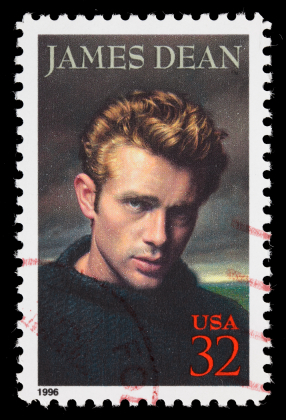
James Dean Legacy in Film

Six degrees James Dean

Robert Towne said this about James Dean’s character in Rebel Without a Cause:

He was the fellow who was going to go to the police and tell the truth. I mean, if you look back, no Bible-thumping Protestant could be more of a reformer than James Dean was … he was the last thing from a rebel.

The actors whom James Dean most admired were those he knew from the Actors Studio in New York. They were under the tutelage of Lee Strasberg and Elia Kazan, who helped to promote the Method. The method actor was probably best understood in the prototype model of Marlon Brando’s performance in A Streetcar Named Desire. Brando immersed himself in the role and became synonymous with the part of Stanley Kowalski. He owned the character. Other method actors followed, including Paul Newman, who also studied the form in New York.

James Dean was from this school of acting, and he also immersed himself in his roles. That is one reason why the James Dean legend endures. The era he was born in, the circumstances surrounding his tragic death at such a young age, and his own charisma and good looks captured a generation of young people.

His legacy began with Paul Newman, who took his part in The Left-Handed Gun and also Somebody Up There Likes Me. Steve McQueen continued to carry the mantle with his roles in The Great Escape and Bullitt.

Newman is an older version of Dean in The Verdict. He plays a man on the skids who is lost, alone, confused, and no longer young. This is a departure for the James Dean mold but one he would have welcomed, I believe. In Giant, Dean also played the part of a man who ages decades in the course of the film.

Other prime examples of Dean’s legacy include Robert De Niro as Jake LaMotta in Raging Bull in 1980 and Sean Penn, another method actor, who won an Academy Award for his performance in Dead Man Walking. These actors immerse themselves in their parts and are known for their grueling prep work before the cameras roll.

There are no apparent newcomers to supplant the role that James Dean created. The rebel hero, the rebel without a cause, the lost, lonely, misunderstood and yet sensitive hero is still remembered as the James Dean hero.

Film noir and existentialism gave us role models such as Bogart’s Philip Marlowe or the French actor Jean-Paul Belmondo in Breathless, but James Dean is an exclusively American icon of film.

In the modern era, Sean Penn would have been the closest thing to James Dean when he starred in the comedy Fast Times at Ridgemont High or his Oscar-winning role in Dead Man Walking. Brad Pitt assumed the mantle in Kalifornia, Thelma and Louise, Meet Joe Black, and Fight Club.

There are no hard-and-fast rules here, but certain standards do apply. The existential James Dean hero is not cut from the standard heroic mold. He is often shy and antisocial; he may be very good looking, but not always. Steve McQueen and Sean Penn, although not as handsome as Newman or Brad Pitt, possess the charisma and emotional capacity to convey extreme angst without losing the aura of cool.

This is a feat that is most difficult to pull off. Very few actors can do this gracefully, yet somehow a few of them have worked in the model or format of the James Dean hero. The legacy will grow and continue to survive as long as the American Dream continues, and as long as new generations of teenagers still exist. It may not be forever, but the James Dean legacy survives on film.