Inherent Vice-The Age of Aquarius

SpInherent Vice imageeaking for myself, this story would not be my first choice of Pynchon’s work to be brought to the screen. The Crying of Lot 49, in my opinion, would be so much more interesting in the hands of a great director. Perhaps that will happen someday, but with this book, Inherent Vice, so many characters are thrown out there and the convoluted nature of the story is so confusing that it just doesn’t add up to anything resembling a linear plotline. Thus, the film version of “Inherent Vice” is a thin thread filled with hidden meanings and some subtle and not-so subtle references, all of which may be easily overlooked by viewers not familiar with Thomas Pynchon’s work.

But Joacquin Phoenix is wonderful as the canny and refreshingly laid-back character of Los Angeles detective Larry “Doc” Sportello. Doc is the quintessential hippie who works hard to seemingly not fit in with the majority of society’s norms. And Josh Brolin is wound wonderfully tight as the completely un-ironic caricature of a button-down cop with the chip on his shoulder and a long-standing grudge against hippies.

Although I’ve always been among those who strongly feel that the medium of film is separate and apart from the printed material of the author’s original book, this film does try to follow the story Pynchon wrote in a fairly faithful manner. It’s not easy to tell if the translation was entirely successful, because some of the visual elements are the funniest parts of the film. Phoenix haplessly walking into the crowd of stuffed shirt cops and being bounced onto the pavement and later, being unsuccessfully hauled by Brolin into the back of a police car are some of the more hilarious scenes in the film. And the least effective portion was the narrated voice-over lifting some of the passages of Pynchon verbatim. It came across as a bit of an over-reach, because the characters and layers of plot should have been enough, without adding Thomas Pynchon’s written words.

The bad news is this film goes long, almost two and a half hours, and could have used a good ten to fifteen minutes of editing to condense some scenes. Many of the cameos and performances by the likes of Eric Roberts, Martin Short and Benicio del Toro are brilliantly cast and spot-on, fitting in perfectly with the absurd nature of the story. The times we lived in and the social commentary on the society we have become are the best take-aways from this sometimes raunchy, sometimes funny film. It’s a must see for all Pynchon devotees, and a good fit for those of us who are “of a certain age” and feel a twinge of nostalgia for the now gone but never forgotten Age of Aquarius.

The Imitation Game

the imitation game Fall 2014The acting of Benedict Cumberbatch is one of the reasons to go see this film. Another reason is this. The Imitation Game is a movie about ideas and how they are incubated.  The notion to invent modern day computers didn’t just pop out of Alan Turing’s head. The film emphasizes the amount of  hard work and the blood, sweat and tears of many people who fought to create something extraordinary. Ideas such as the ones that made the machine that broke the Enigma code possible only came about when some were willing to fight for their visions.

My one criticism would be the part of the film that dealt with Alan Turing’s homosexuality. It seemed to be slapped together to complete the story somehow. But the more interesting part of the film deals with the culmination of the brain child of Alan Turing and the accompanying risks and responsibility the knowledge of the code entailed.

The men and women who worked on this project were not able to speak of it for decades. There was no glamour or glory for these people. It was a hard fought slog of a war, and the action of this film, quite naturally, takes place within the confines of a quiet town in the English countryside. The dramatic license found in all works of Hollywood fiction make up a small portion of the action, but there really is no melodramatic dilemma found within the story of the Enigma code breakers.
The fascination is found within the confines of the mind of the visionary Alan Turing character.

Which is why only an actor such as Cumberbatch could play such a man. Some of the unlikeable elements of his quicksilver-tongued Sherlock appear in the Turning character at times. But the bulk of the film is carried by Cumberbatch’s focus on the single-minded dedication to detail seen in the makeup of Turing.

Out of a very poor season, and frankly a stunningly slow year for movies, this film stands out in the crowd. Now up for Best Picture, as well as Best Actor for Cumberbatch and Best Supporting for Keira Knightley, this is one film that easily wins my vote. Go see this movie.

Taken 3-Capsule Review

Liam NeesonIn order to complete this review, let’s game this out logically. What should you do with a hit movie theme that needs a spark of imagination and creativity to move the characters development along?

Plot # 1 would have Liam Neeson, a man with “a special set of skills” but also one with a softer side when it comes to his grown daughter and his ex-wife, doing something different this time around. You could pick up the action by tacking back to the history of his friendship and loyalties with his military buddies in special-ops. And expand from there. Like James Bond, you might pit his wits and expertise against a formidable foe- a Dr. No or a version of  Professor Moriarty, as found in Sherlock Holmes.

 Or, you could just write a plodding and fairly pedestrian story about some thugs who killed your ex-wife. And waste the talents of a good actor like Liam Neeson in a very run-of-the-mill re-hash of the same story. What should you do?

In the case of Taken 3, the easy way out was the road taken in this forgettable film. Only Liam Neeson die-hards need apply for this outing.

The End of the Interview

The interview pixThis has to be one of the least funny comedies I’ve ever seen. This film should have gone straight to video, but not for the same reasons it did become controversial. There is really no point to the plot. And for that matter, the plot points that supposedly flow from scene to scene make this a jumbled mess of a story without rhyme or reason.

There is no need to bring in the CIA in the early stages of the story to act as the straight man for the initial plot to kill the leader of North Korea. For that matter, why not make it a fictional country or just change the name of the real leader? This is not a deep film. Nor is it one that is well planned or executed.

It’s a genre that is known as juvenilia. I suppose that the target audience would be twelve to fourteen year old boys. Lots of butt jokes and juvenile humor combined with some gory scenes round out the hilarity.

Seth Rogen and James Franco are better than this mess. I would be embarrassed to think the President of the United States and other leading statesmen might waste their time watching this piece of you-know-what. It’s not worth a trip to the movies, or even a download. This is…so bad it’s not worth even talking about-or writing about! End of story.

The latest Exodus: Review


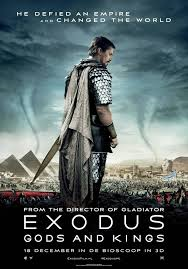
Exodus pixThis film was so much better than the previous attempt at big box-office Biblical fare-Noah. The elements of the story, for the most part, have been left intact. One question I do have for the marketers of this production…why release it at Christmas?

This film is about Passover, as we all remember. It should really be an Easter release, but since I’m not involved in marketing for the film, I can only shrug and wonder why?

Director Ridley Scott attempts to recreate ancient Egypt as he did ancient Rome in Gladiator and the futuristic city of Los Angeles in Bladerunner. He does a credible job in portraying the building of the pyramids, complete with oppression and cruelty to the enslaved Jews. There are some slight remnants of the great and overblown The Ten Commandments (1956) found in the first part of this movie. But the pomp and spectacle never threaten to distract from the focus of the film, which is not true of the fifties VistaVision version directed by Cecil B. DeMille.


Moses is portrayed as a general and a master tactitian, a skilled negotiator who is admired by his troops and his adopted royal family. The plot then moves Moses into the desert thus setting up his initial encounter with God. His subsequent dialogue with the God of Abraham shows the Lord depicted in the guise of a young and extremely self-possessed (other critics have used the term petulant) boy. This depiction works for me, however, some may be offended with God shown in any kind of human form.

One complaint that is justified is the running time. The film runs two and ½ hours, a long time, but the film is not so terribly edited that the action seems padded or plodding and it’s not dragged down with lots of unnecessary plot points or detail.

The parting of the Red Sea is always the big highlight of any  Exodus story. In this film, it’s handled extremely well. Although Moses has been depicted on screen for over one hundred years now, this version allows for the imagination of a creative director, Ridley Scott, plus the combined assets of historical and religious sources added to the creation of CGI effects all brought together to weave a narrative that mellows the histrionics found in DeMille’s spectacle and grounds the story to a semblance of reality.

To be sure, there is spectacle of sorts in this version. But the story focuses on the dialogue between Moses and God and the dynamic leadership embodied in the character of Moses. Christian Bale was a good choice, though not without controversy, as witnessed by the critics crying foul in casting a white man (again) in the role of Moses

To sum it up, this was a satisfactory depiction of a story with so many variations and fascinating elements, it would never be enough to simply tell it once. This is the first CGI (Computer Generated Imagery) depiction in a new era of expanded Biblical and historical enlightenment. I doubt this is the last retelling of the Exodus, but for now, it’ll do.

About The Interview

The interview pixWith so many films of struggle and hardship, the light comedy, “The Interview”, was going to be a welcome respite this holiday season. Sadly, this film has taken on the dimensions of an international coup…

The irony from my perspective, is that the satire focuses on the CIA’s notion that one should or could “take out” the leader of a foreign country! The joke may have been intended to cast a satiric light on the American system…but instead the attention has been misdirected. If the filmmakers had decided to change the name of the dictator, or used a fictitious country, as in the excellent fifties film, ‘The Mouse that Roared”, which poiked fun at the Cold War era and America’s nuclear policy, then the film could have been released.
Political satire, as in the classic “Dr. Strangelove”, is often aimed squarely and rightly so, on the (at times) dubious and questionable practices used by our own government. We live in an open society which allows us to use free speech to question the authority of our government and encourages dissent. But in the world of cyber terrorism, and of terrorist regimes in general who are determined to bring down and destroy our way of life as a free and open society, it’s a pity we must pull this film from circulation.
One can only hope that lessons are learned and that we may be able to see this film, however innocent and light it is, as the filmmakers intended. Preferably sooner rather than later.

Interstellar: A return to old-school Sci-Fi

Interstellar 2014This film is a highly fanciful return to old-school sci-fi movies. There is some science interspersed with fiction, making it more akin to last year’s Gravity than Kubrick’s 2001 , to which it has been favorably compared. It’s not quite up to the standards of that classic film, but that doesn’t mean one should dismiss it completely.
Matthew McConaughey is adequate, but not wholly comfortable within his character, retired NASA pilot turned farmer Cooper. His role as pilot extraordinaire and earnest engineer lays rather heavily on his shoulders. He’s much better cast as the loving father and farmer in the opening segments. Anne Hathaway seems miscast in this piece, and literally adrift within the space opera. Michael Caine’s character of Professor Brand seems to be almost written in as an afterthought, which means it’s a bit confusing as to why he’s there. John Lithgow as Cooper’s father-in-law is similarly under-utilized in the script.
Only the character Jessica Chastain portrays seems to be well-rounded. She’s completely comfortable in her role as the daughter Murphy, who is left behind on Earth. The story centers around a wormhole discovered by NASA scientists after an apocalyptic Earth event. McConaughey and crew must travel through it to three possible planetary candidates in order to ostensibly re-colonize the inhabitants of Earth.
The plot holes are big enough to fly the Starship Enterprise through with plenty of room to spare. This is not high-brow sci-fi, but this movie, special effects notwithstanding, signals a return to the old-school style of science-fiction space operas we remember from the fifties and sixties. Films like Forbidden Planet, or Invasion of the Flying Saucers come
to mind if you’re old enough to remember such flights of fancy. In other words, you must suspend disbelief and simply enjoy the special effects. At some point, you may even check your watch as the running time is 169 minutes, well in excess of 2 ½ hours.
This film comes not highly recommended, but recommended for lovers of science fiction. As long as you walk in with your eyes wide open, and not expecting the wonders of 2001: A Space Odyssey, you probably won’t be disappointed.

St Vincent- The Dark side of Murray

St vincent Fall 2014Bill Murray’s Vincent doesn’t want to know his neighbors. And when Melissa McCarthy, his neighbor, finally becomes laden with pain and misery, she knows better than to tell her crabby neighbor Vincent. “It’s a long story” is all she volunteers, knowing he couldn’t be bothered with the details of her sorrow. Yet he reaches out to her in the most telling and cursory way. It’s a pivotal moment, yet a quiet one in an uneven film. “What’s the punch line?” he asks. For this character to even ask is a major breakthrough.
The film, St Vincent, is a dramatic one with occasional touches of the signature comic relief we’ve come to expect from Bill Murray. The showstopper is the child that binds the curmudgeonly character to the rest of the plot. Without him, the film becomes unworkable. The knocks on this plot come from critics pointing out the fable elements of the story which are introduced late in the film. But there’s not enough saccharine sweetness to throw off the rhythm of the basic premise-St. Vincent is no saint. However, looking beneath the dark surface, there is also light. That is the point. This is Murray’s film, and he plays the part well. No one else would attempt this unique role, or be able to pull it off as Bill Murray does.
The dark side of Murray has always been on display. It took St. Vincent to shine the light on a gifted actor born to play the role of this particular curmudgeon with a heart of gold buried deep inside. There are some 6 degree elements when you consider Jack Nicholson’s take on the funny miser in “As Good as it Gets”. But for the most part, this is simply Bill Murray, warts and all, on display as we’ve never seen him. There were some hints of the dark side in “Scrooged”, but Murray was simply too young to play a full blown bore. And we’ve always known he’s had it in him to play this darker version of himself. Without holding back, he is spot on, hitting all his marks with humor and bad grace.
If you love Bill Murray, you should complete the circle and see this film. We’ve known him as the wise guy, the talk show persona, his Saturday Night Live characters, the comic hero & legend, and then there’s the dark side of Murray. Here is the maverick who doesn’t give a damn, but we like and admire the honesty on display. The wit is still there, without the charm. Don’t be fooled by the previews, this is not one of the early Murray comedies. This is more a dramedy, perhaps. But it’s well worth the effort for those who’ve loved the characters that Bill Murray has portrayed through the years. St. Vincent is one that completes the circle.

Bogey’s F. U. Money

Humphrey_Bogart_by_Karsh_(Library_and_Archives_Canada)Bogart was an original. A truly complex individual, his background encompassed the sophisticated world of New York Society in which he was born and raised all the way through to his gritty life in the Navy and onto the uncertain life of a Hollywood actor. After leaving the Navy, Bogey started his acting career on the stage and was even credited with popularizing the effete term, “Tennis, anyone?’ early in his stage career.

He eventually went to Hollywood and landed roles as a gangster “heavy”. Although not traditionally good-looking, he finally managed to break free of his stereotyped villain’s image and became a leading man in romantic roles in his later years. His deep voice, tempered by years of heavy smoking, and his ultra-cool persona finally worked to establish him as a credible actor and then transform him into a major star.

But Bogart worked in the era of the Studio Bosses. His boss, Jack Warner, held an iron-grip on his employees, which included all the actors who worked at Warner Brothers.

Bogart frequently found himself in disputes with Warner and the Studios over his salary and his schedule. Big studios were notorious for lending actors out to other studios, even if the parts were fairly minor. Bogey balked more than once. And in order to back up his threats to walk, he would often speak of his F. You Money (In Bogart’s case, he would fill in the blank where the F is!) This money was his hedge, a special fund set aside that would enable him to make good on his promise to leave.

This was also part of the ongoing fight between management and labor over forming a union. The studios fought tooth and nail to prevent actors, writers, and other film workers from unionizing. In the end, unions prevailed. In the fifties, the studios caved in to government pressure when faced with the threat of a shutdown during the McCarthy hearings. They fired and black-listed many talented artists of the era after their names appeared on Joseph McCarthy’s list.

Bogart was one of the voices that was front and center in the group traveling to Washington to protest the House Un-American Committee. Bogey was a Maverick throughout his life. He fought in one form or another against the studio bosses and against many other forms of discrimination, oppression and injustice.

Would that we had more Bogey’s these days. Those men and women, like Bogey, with the courage of their convictions to stand up against the powers that be, whether in Washington or globally. It’s not a bad idea for anyone to set aside their own personal F. U. Money fund. It’s a nice thought that you may have a special fund to help you walk away when you know the time is right and you need to back up your rhetoric with action. In Bogart’s case, the F.U. Fund was real and so was he. As is often heard, they don’t make ‘em like that anymore!

Fury-Capsule Review

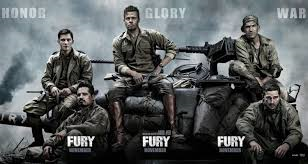
Fury 2014What’s the point of making what some critic referred to as a “B-movie about World War II” in this day and age? The acting is the best part of this film. Shia Labeouf does a credible job as does Brad Pitt in the suitably intense role of “Wardaddy”, the leader of a band of men fighting in a tank during the last days of the European combat theatre in WWII.

The point: Resolve on the part of the U.S.  And belief in finishing the job. So when assigned to hold an important road, the leader of the team doesn’t question authority nor does he shirk his duty. All of the important words: duty, honor, courage, and heroism in the face of insurmountable odds-all of these factors are in play here.

One of the stand-out scenes in this mostly by rote war film depicts Pitt/Wardaddy going into a civilian German apartment and simply sitting down and behaving as someone would who is on holiday. He is simply taking a break from war.

Although not quite as effective as, say Spielberg’s use of the child in the red coat inserted into the stark black and white film, ‘Schindler’s List’, this gives us a stark and vivid reminder that not everything in war is black and white. Sometimes the nuances we see or infer become the most memorable take-a-ways from a film.

In some parts of the action sequences, I remembered how my father, a World War II veteran himself, would speak of the way the United States was always depicted in a war film. The John Wayne Mythological hero was just that -a myth. While the Allies were basically a brave and honorable group of men, no one was above reproach when it came to the treatment of Prisoners of War on the battlefield.

This film reminds us that the bravery we see is still very real in times of war, and the morality, or lack of it is sometimes lost in the “fog of war”. It makes even the most moral and upright souls begin to question their humanity and at times, even the existence of God. If that’s not part of the message of this film, then perhaps it’s one that should be considered.

And perhaps the revival of the WWII soldier/ensemble movie will continue. Or maybe this is the last gasp of a dead genre-but for those who love action/adventure films, or war movies in general, this film should satisfy.