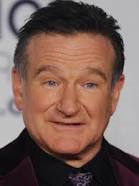
 The funny thing about Robin Williams death is that it is a shocking thing. It does not surprise us that he died, but the fact that he was able to stem the light from such a great ball of energy that was his existence is shocking for most of us. We knew him, and felt we knew him, because he made himself accessible to all of us.
He was so vulnerable and sweet, that even the most cynical and cutting of comments that he made came out in a rush of love and humor and little-boy badness. No one could fault him for telling the truth. He was who he was. He was a great talent and a troubled soul. Warts and all, we could see in his eyes the light of that sweet and vulnerable soul.
I’m reminded of a comedian on Jon Stewart’s Daily Show talking about the Crocodile Hunter’s death. Although it was tragic, the comic said, “For a Crocodile Hunter, 42 is a ripe old age!” In retrospect, Robin Williams lived to the fullest for the 63 years we knew him on this Earth. He burned so brightly that the light was bound to flame out. That is the curse of genius and the blessing. We are lucky to have known such a man through his work. Flame on forever, Robin. You may find some peace and a place to lay your weary head.
6 Degrees Summer Newsletter Part I
It’s hard to get worked up about the Summer Movie Line-up. It looks awful. I’m glad I don’t have to push this stuff for a movie studio…it would be like touting the line that cigarettes aren’t so bad for you after all! You know it’s a lie! Some of the summer movies are out…others are to be released after the holiday weekend and into August.
Here’s some thoughts about the upcoming Summer Movie Season:
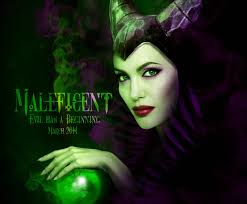
“ Maleficent” with Angelina Jolie, has received good reviews. John Schwab reviewed it favorably on his blog, My Film Journal. “A Million Ways to Die in the West”is no Blazing Saddles for sure. It opened with lukewarm reviews. Tom Cruise in a sci-fi movie? How interesting is that!? My answer would be…not very. But, his new film, “Edge of Tomorrow” has received positive reviews, and it looks like a movie that gamers would probably find interesting enough.
On Documentaries: The only thing that looks interesting are the documentaries. Why? Because there are so many remakes and rehashed plots out there, you would not be able to sit through them as a film critic without beginning to pull hair out. The summer movie line-up contains the most disappointing assortment of movies I can remember. Nothing looks good. Clive Owen is in a film, “Words and Pictures”, and Academy-Award winner Colin Firth starred in “The Railway Man.” Neither one of these movies was shown in our area.
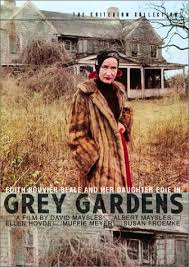
Grey Gardens: I had never seen “Grey Gardens” It is hardly watchable in one go-round. But it’s one of those films where you just can’t look away. The two characters, Big Edie & Little Edie, are just so gloriously bizarre. The filmmakers, Albert and David Maysles, in one of their earliest cult hits, decided to ditch the original project they were contracted to do-a documentary on the Bouvier family-Jackie Onassis’ family. Instead, they focused on these two, sad, eccentric females living in splendid squalor in a house called Grey Gardens.
The idea came to me while watching this film unfold is that all of us have eccentricities. I was fascinated by the two women, as I live with my mother, and we are roughly the same age as the two featured in this precursor to all reality shows. My thinking is that all of us who live into our mid-century years could be found to be eccentric in our views and our behavior. Not quite as much as these two, who are somehow caught between the old & new worlds/the past & the present life….
Yet seeing our own quirks & peccadilloes, we become conscious that we are not all on display for the world to see. I still contend that it may be something of a quasi-comic-tragedy to follow some of us around with cameras!
Other documentaries that are interesting: The maker of “The Fog of War”, Errol Morris, who made one of the best films depicting an anti-war message with the late Robert McNamara–has made a film with Donald Rumsfeld, “The Unknown Known” There is also a great documentary out on Anita Hill: “Anita”. These are probably better than most of the feature films coming out. But you would have to be interested in political history to really appreciate both of these.
As promised, here is a line-up of Recommended Reviews by Critics. Some of these reviews are not glowing endorsements, but instead thoughtful pieces that are meant to compel those with an interest in the subject matter to go or to stay home or to see it later and just put it on “the list”. Mine is an ever-growing list of films that I can’t possibly begin to finish. But some of the films are ones that I haven’t seen or have wanted to see. Others have not made it to our local theatres yet. They are:
Recommended Reviews by Critics:

The Rover: theguardian.com/Rollingstone.com
Of Horses and Men: theguardian.com
The Grand Seduction: chicagotribune.com
Supermensch: The Legend of Shep Gordon: chicagotribune.com
Jews of Egypt: chicagotribune.com

Words and Pictures: chicagotribune.com
Maleficent: latimes.com
Calvary: theguardian.com
6 Degrees-Our Connections with Film
To all my friends followers, and fellow movie lovers who have followed 6 Degrees of Film,
I am working on a different dynamic for the blog I’ve written for the past seven or eight years. In that time, the way our media culture has changed is overwhelming. It really is overwhelming for me, at times, and I’m sure many readers who just don’t feel as organized or connected as we should. I know I feel that way about covering film and a myriad number of other topics that I write and blog about.
Political writing, in fact all writing bombards our e-mail boxes, and fries the brain. Any number of worthy causes out there threaten to swamp us with outpourings of e-mails asking for our time and our money. I’ve decided to try and scale back on some of these projects and causes, not because they aren’t worthy, but simply because I will not be able to answer the call. That’s the problem with life. We just don’t seem to be able to answer the call and then perhaps we feel guilty or inadequate when we can’t do it all. That is how I feel at times.
But no more! I’m turning over a new leaf and part of this includes my writing and my blog posts. I’m still blogging, but simply not as frenetically and haphazardly as I was. There needs to be a plan in place. One of the happiest parts of the plan is the book I finally finished last year. 6 Degrees of Film is the culmination of many years I’ve spent blogging about film. Some of the reviews that I’ve posted are included in the book. But most of the material is new.
Now I’m not asking anyone to buy the book. Some of the material is reprinted on the blog. But, I’m hoping to build on the success of my book and blog and would ask those who love film to sign up for the newsletter I’ve been writing. The next one is out in June. One of the things I’m continually writing about is the way we connect with film. The 6 Degree connections thread through our lives and connect many of the films we have loved in the past with some of the films we are watching today.
On Reviews: One of the things I have written about in the book is the need for film critics to write clearly and concisely on film. Roger Ebert and other critics like him have been sorely missed in past years. Something else I have been actively pursuing is a way to connect some of the better parts of the multi-media culture with film criticism. That has led me to a section on the blog for Recommended Reviews by Critics.
One of the other things I’m excited about has been the development of Capsule Reviews. These reviews are usually pretty short, but they give you a good idea of what a currently released film is all about. Of course, there are still going to be lengthier sections on the blog for more in-depth coverage of film. But these will be previewed in the 6 Degrees Newsletter also.
Stay tuned for more from 6 Degrees of Film. Here’s watching with you!-MLJ
On Saving Mr. Banks-Capsule Review
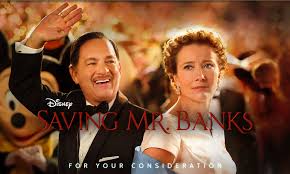 This film was marketed as a comedy. Yet it is anything but comic. It’s a fairly accurate portrayal of the struggle for artistic control of the Disney classic Mary Poppins. Everyone knew, even in the sixties just what type of films Walt Disney made. And if you were a rather dour Englishwoman with a limited world view than you would not be amused. This is the basic tone of the film. It’s not amusing, and it’s rather sad at times. It’s also full of distracting flashbacks and that is one of the reasons the film doesn’t work. The author, PL Travers, played by Emma Thompson is seen as a young girl who worships her father. We see her again as an embittered middle-aged woman with a joyless existence. The two characters are never reconciled in a satisfactory manner. There is no “hook” that convinces us this is the same person. In the film, Capote there is a device used where the character of Truman Capote is seen as regressing to a different time in his mind, and the device they use is a jar of baby food he uses to drink his booze. There is a similar sequence in this film using pears, and it is doesn’t come across in the same manner. This takes great editing and even better scripting. This film needed some work.
The child that was Travers is a sweet and innocent vision completely enamored of her charismatic and charming father, played by Colin Farrell. There is no trace of humor or softness in the character of the woman that is PL Travers. She doesn’t endear herself to the Disney people nor to the audience. Tom Hanks is spot on as the charming Walt Disney, bent on cajoling and charming Travers into submission. But his time spent on screen relegates him to something of a minor supporting character.
Thompson carries the movie, and she does an admirable job. The film in tone is much closer to Remains of the Day than any of her other work. In another Thompson vehicle, Nanny McPhee, it was billed as a lighthearted attempt to entertain, and this film is marketed in the same vein. But it’s a sad portrait, accurately done, about a writer’s struggle for control. And also about a woman who cannot let go of the past. These dramatic storylines don’t ever let us forget the sadness and the sorrow she carries. And then, there is never really a satisfying denouement or closing. Rather like Remains of the Day, the sadness and emptiness of the characters are the only takeaways allowed.
Capsule Review: Her
 Her shows us an impersonal world, a colder world where even the warmest hearted individual is often surrounded by an isolating and sterile atmosphere. Work is done in isolation from others. Even sex is seen as an isolating event.
Conversations are all one-sided, as we see people walk by on the streets-each in their own separate bubble of solitude. This theme of separation and isolation really dominate the film. It’s been suggested that this movie is about the nature of love, but it’s really the isolating nature of the future we are witnessing. It’s the future we’ve set up for ourselves. The couples in the movie surround themselves with separate visions of technological progress and they work hard to establish their own individual identities. Therefore, it’s even harder to penetrate the layers of technology that engulf each of us. This seems to be the underlying message. Even as we’re together in body, we are alone and separated from one another by our own free will.
This shows us a sobering yet realistic tale of the future that rings true. It’s a future we may find hard to accept, yet in the end we don’t want to look away.
The performances by Joaquin Phoenix and Scarlett Johansson –she’s the voice of the operating system –are compelling and pitch-perfect. The solitary nature of the main character is given a sympathetic and honest face with the performance by Phoenix. He leads us into this world where each individual is placed in a kind of vacuum of existence. In the end, there’s not a lot of answers, but there are many interesting questions raised by this future world.
What is the future of our relationships when so much of our time leads us down a virtual rabbit hole that is void of all human contact? How could we recognize a real or simulated emotion if we have no experience with genuine human emotions? What makes a relationship real and lasting? And what is the true nature of love in this future world? These are the great questions raised as part of the landscape we are drawn into in Her.
Films that Endure
The films that have won the Academy Award for Best Picture over the past decade have been, for the most part, forgettable. With the exception of No Country for Old Men and Slumdog Millionaire, the winners have not been the pictures that will pave the way for a new creative vision for the 21st Century. The winner for this year is no exception.
12 Years a Slave is an important footnote in history. But Gravity and Her were the two films impacting our lives with a vision of the future of film. In Gravity and in Her, the theme of isolation is pursued. For the milennials who are coming of age in this decade, that issue will be front and center.
Although it can be argued that slavery still exists in the world, the idea that we will continue to see this film as one that may impact our lives far into the future is remote. In Her, the idea that someone may fall in love with a voice encapsulated within a computer operating system is one that presents questions and challenges us to contemplate the nature of our relationships in the near future.
These are the films that will endure. The ones that stay with us and make us think are the films of the future. 12 Years a Slave does make us think of our past and who we were as a nation and a people. We have collectively moved on from a shameful period in our history. The U.S, along with many other nations, (Germany and Japan come to mind) will continue to deal with their inglorious past sins visited upon the human race.
Some of the films nominated for Best Picture were hard to watch. The Wolf of Wall Street also dealt with an issue currently in our culture, that of greed and amoral behavior. There will always be a place in Hollywood for tackling tough issues and shining a light on society’s moral failings. But when we look ahead into the next twenty or thirty years, we will see a different audience and a new way of looking at the world.
The trends are taking us far away from linear action, the traditional screenplay dialogue, and into a different focus, and new ways of advancing the story line. Hollywood and mainstream cinema seems to trend at least a decade behind the independent or experimental films. But in at least two films of the past year, Gravity and Her, we see the marked beginnings of a different type of film experience taking us along and pulling us into the 21st Century.
Noah and the Ark
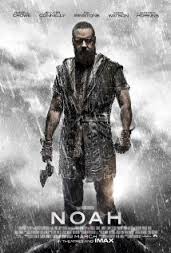 This is definitely an action/adventure film. Noah is in the category with some of the old Hercules films (They’re making a new one of these too!) This film is not an epic, nor is it a sweeping apocalyptic vision. It may well have had aspirations to be this type of film, but the reality falls short.
License was taken. License was taken to “flesh out” the story of Noah. And the irony is this: if Anthony Hopkins had played Noah, and Russell Crowe had played his eldest son, there could have been a damn good film made of this ancient story. But the reality of the Darren Aronofsky version is that it’s not a great film, nor is it a memorable one, but instead a tolerably decent story of Noah and the Ark.
The problem may lie in the method of trying to be all things. Noah fights in this film because we expect Russell Crowe to fight. Anthony Hopkins is the wise sage, because he is seen as the elder statesman. There is an obligatory young love interest, but it’s not so interesting after all. And the animals, which are at the heart of the tale of the Ark, are really used as an afterthought.
In fact, the computer generated models look downright fake at times. This is disappointing in an age where visuals are everything in a film. That being said, the film does have some interesting parts. They have written in a “stowaway” on the Ark, which is completely out in left field, if you are a strict constructionist regarding the Bible.
The rock creatures, fallen angels that help Noah to build this Hollywood version of the Ark, are particularly problematic in my judgment. In much the same way that Jar Jar Binks irritated the faithful fans of Star Wars, this addition to the story of Noah doesn’t really ring true. Yet the makers of the film must have felt the story needed that extra “oomph” that only rock creatures could provide. Go figure.
The plot thickens with just enough overtones of Mad Max to make the landscape look like something right out of Mad Max beyond Thunderdome. Everything is thrown into the plot pot and stirred. Where another directors vision might have included more plot development on a less grandiose scale, this director needed to pull out the action/adventure stand-by’s to keep this film moving along.
Would Noah and his family finish the ark before the evil army destroys their boat? Will Noah decide to let his family line die out after the flood? We know Noah and his family make the cut, so therefore we must have some type of added flavor to the story. One would think building a boat that houses all of the species of animals on the planet would be enough. Yet that is glossed over in about 5 minutes of air time.
Russell Crowe is a brilliant actor. He is not exactly miscast in this role, still he would be better served as a passionate Patriarch overseeing the New Beginning that conveys his Covenant with God. And yet, Noah’s role is not at all clear. He interprets the signs from the Creator, yet he’s never sure. And we are never sure of him.
This darker Noah is angst-ridden, filled with doubts and guilt. He doesn’t seem to have a focus for his energy. Is it his Love of God, his duty to family, his role as Preserver of the Earth, or the Keeper of the Animals? We are never sure.
In “The Bounty” there were some great scenes with Anthony Hopkins and Mel Gibson sparring with each other as they vied for the control of the ship. In this voyage, Russell Crowe as Noah flounders to understand his place. In silence, we see him struggle but never feel connected. And even the frames are at times disappointingly disjointed as they look more like storyboard stills then a cohesive and flowing picture.
Too many times the hand of the filmmaker intrudes and you may even think, “This looks like a storyboard.” That’s not what you want the audience to muse upon in the middle of a motion picture. When we know the characters will make it through alive, there has to be a compelling sub-plot. The rock creatures and the stowaway just don’t cut it.
In the end, it’s an interesting effort that would earn a B- or C ….2/1/2 stars perhaps…if we were judging this film on some arbitrary rating scale. It could be recommended only if you are curious about the logistics and execution of Noah’s Ark, and not a satisfying storyline.
Timeline for Oscar: Ground-breaking Best Picture Oscar winners
 Recently, film critics were musing about the impact that the Academy Award-winning films have had through the years. The conversation continued questioning the influence that major Hollywood films have had on society through the years. The question arises: Does Hollywood simply follow trends or does it sometimes reflect the cutting-edge of our society in terms of morality and social norms?
A look back on the past century sheds some light on the films and their impact through the years. The first award for Best Picture went to Wings in 1927. This was the only silent film winner until The Artist won in 2011. There were really only a handful of outstanding movies that won Best Picture before 1934, and they reflected the current trends of the day. Since westerns were very popular in the early days of film, Cimarron won the Best Picture award in 1930.
In 1934, a screwball comedy won. It Happened One Night also swept the major awards, giving Clark Gable and Claudette Colbert both Best Actor and Actress Oscars, respectively. You Can’t Take it With You, winner in ’38, gave Frank Capra another Oscar win. This picture, quaint and dated in some ways, also takes a serious look at the notion that success in American life depends on the amount of money you make and how hard you work. We are still grappling with this notion regarding the lifestyle and values of the American middle-class.
Gone with the Wind was a blockbuster in all respects. Clark Gable, already a star, established himself as an icon in the role of Rhett Butler. The cinematic accomplishments of David O Selznick are still celebrated with this landmark production. Many critics argue that 1939 produced some of Hollywood’s greatest films. It was a landmark year, and there were other years with similar lists of films all deserving of the Oscar.
During the 1940’s, Rebecca won the Oscar for Alfred Hitchcock (the only one of his many films that won Best Picture, although he never won a Best Director Award!). Casablanca, winner in 1943, was probably the most famous film of the forties to win the Best Picture award. Yet, The Lost Weekend was also a landmark film in many ways.
It addressed the problems of alcoholism and, despite its dark subject, it managed to win the Best Picture award for 1945. America was changing, with many darker films in the film noir genre being made in this time period. In the book 6 Degrees of Film, the reasons for the rise of Film Noir, with all of its darker connotations, are discussed in detail.
The Best Years of our Lives won Best Picture in 1946. It dealt openly with the many problems that veterans faced after coming home from World War II. In Gentlemen’s Agreement, the winner in 1947, another tough subject was acknowledged. The subject was anti-Semitism, and few movies before or since dealt with the problem as successfully as this film.
Hamlet, Best Picture of 1948, was a chance for Hollywood to give a nod to not only the Bard himself, but one of the most revered cross-over actors-one who came from the stage and successfully transitioned into Hollywood-Sir Laurence Olivier. In 1949, All the Kings Men, although not as well known outside of political circles, remains a respected look at the corruption that political power may bring.
All About Eve, Best Picture in 1950, is definitely one of Bette Davis’s most well-known roles. The film has endured with movie buffs and Davis fans over the years. In 1951, a landmark film won Best Picture-An American in Paris. Gene Kelly created many timeless dance numbers and the film endures as a monument to his skill and unsurpassed technique regarding the art of the dance.
In 1953, From Here to Eternity won Best Picture. Again, Hollywood tackled tough subjects confronting society. Described as a “realistic portrait of the U.S. military”, this film was one of the raciest of its generation, as it included the famous scene with Burt Lancaster and Deborah Kerr making love on the beach.
In 1954, On the Waterfront won Best Picture. This film broke ground and is described as a “tough, uncompromising look at corruption on the New York waterfront”. It also showcased the incredible talents of a young Marlon Brando. Another stand-out film of the fifties was The Bridge on the River Kwai. Winning in 1957, this film also took a hard look at some of the harsh conditions that prisoners of war endured during World War II.
In 1959, Ben-Hur, one of the classic action-adventure films, won Best Picture. The year before, a light musical, Gigi, won Best Picture. These two films ushered out the fifties. The studios were in decline and television was on the rise. Many aspects of our culture would change in the next ten years, and it was reflected in the types of films Americans went to the movies to see.
The winner for Best Picture in 1960 had a controversial subject. The Apartment, dealt with an executive who kept an apartment on the side for his extra-marital affairs. In 1961, the winner was West Side Story, which told the story of a modern day Romeo and Juliet, a pair of star-crossed lovers living on the West Side of New York City.
Another Best Picture winner was Lawrence of Arabia in 1962. The film lives on with so many great performances and the hauntingly beautiful music that surrounded this epic masterpiece. In 1964, the award for Best Picture went to a film with much lighter content. My Fair Lady acknowledged the talents of Rex Harrison and the memorable music surrounding the hit play.
By 1965, the musical was on the decline. Yet through it all the beautiful scenery and memorable music from The Sound of Music gave the film the necessary ingredients to win the Best Picture award that year. A Man for all Seasons, another play adapted for the screen, won in 1966. And in 1967, the acknowledgment of the changing mores and societal norms were examined in the Best Picture winner, In the Heat of the Night.
By 1969, the American psyche was ready to give the award to a film about a male prostitute. Midnight Cowboy won Best Picture in 1969. Yet in 1970, another movie about war and the personalities of the men fighting wars was examined. Patton was awarded Best Picture.
The French Connection, a landmark film which centers around one of the most harrowing car chases ever filmed, won Best Picture in 1971. But 1972 saw a sea-change in film-making when Francis Ford Coppola’s masterpiece, The Godfather, won Best Picture. The art of cinematography plus acting and directing were melded to produce one of the acknowledged great films of all time.
In 1973, The Sting won Best Picture, which gave a nod to one of the greatest duos in screen history-Robert Redford and Paul Newman. The Best Picture award went to The Godfather Part II in 1974. And in 1975, Hollywood insiders and moviegoers were excited by something that had not occurred since It Happened One Night in 1934. One flew over the Cuckoo’s Nest took all three major awards-Best Actor/Picture & Actress.
The seventies contained so many landmark films and introduced us to many screen greats that are still with us. 6 Degrees of Film chronicles the cutting-edge technology that was spawned during the making of one of the most celebrated films of the past quarter century: Star Wars. Although it didn’t win, it was nominated for Best Picture in 1976.
The movie world also buzzed in 1976 with the arrival of Sylvester Stallone’s Rocky, which won Best Picture that year. And in 1977, Woody Allen became officially “mainstream” with his Best Picture winner Annie Hall. Another film which introduced us to one of the legends of the screen was The Deer Hunter, starring Robert De Niro, Christopher Walken and a very young Meryl Streep. It won Best Picture in 1978.
During the 80’s, there were several ground-breaking films and film processes that were taking place. But the Best Pictures, arguably, were not as memorable. Chariots of Fire, winner in 1981, did contain a memorable musical score
And Platoon, which brought Oliver Stone onto the public stage, was another hard look at the realities of war. It won in 1986. In 1988, Rain Man won Best Picture. Looking at the Best Picture list, Rain Man easily qualifies as one of the best films made during the 80’s. And in 1989, Driving Miss Daisy won Best Picture. Here is another look reassessing the relationships African-Americans have had in the South over the past fifty years.
Dances with Wolves won Best Picture in 1990. Although not a memorable winner, it was an acknowledgment of Kevin Costner’s box office appeal at the time. In 1991, one of the more significant films of the past two decades won Best Picture. The Silence of the Lambs was one of the first thriller/horror pictures to win. And it established the unforgettable character of Hannibal Lecter, a villain explored in countless knock-off films since. Unforgiven won in 1992. The Academy acknowledge the body of work of Clint Eastwood, and in doing so, gave the Oscar to a Western for the first time since Cimarron won in the 1930’s.
Schindler’s List, which won in 1993, acknowledged the genius of Stephen Spielberg. And in 1994, Forrest Gump honored a new phenomenon. The genius of Industrial Light & Magic, George Lucas’s special effects studio, which created the memorable effects in Forrest Gump.
Braveheart, the 1995 Best Picture winner, recognized the box office appeal of Mel Gibson. But the studios and film world were all taken aback in 1997, with the success of Titanic. The Best Picture winner won in so many different categories and broke all attendance records. Even former Blockbuster films paled with the success of this landmark film James Cameron, the director, was suddenly acknowledged as a leading power broker in Hollywood.
In the last ten to fifteen years, we have had few groundbreaking films winning the Best Picture award. Gladiator in 2000 was a blockbuster. And Lord of the Rings: The Return of the King, the Best Picture winner in 2003 is on the list of highest grossing films of all time. (Titanic and Gone with the Wind are also on the list).
With so many changes in the industry, the emergence of high-tech computers, digital imaging and a new era in special effects cinematography, there is an acknowledgment of the Oscars as a sometimes quaint and old-fashioned kind of award.
However, there are still trends emerging in the categories we see that include the Best Picture of the Year. In 2007, No Country for Old Men acknowledged a new kind of nihilism and realistic landscape that the viewing audiences were seeing in mainstream cinema. And the winner in 2008, Slumdog Millionaire, has probably been one of the most significant Best Picture award winners in the last ten years.
Namely, because it reflects the trends in Global Marketing for films. No longer are audiences watching films that play for the isolated market that was found in the United States perhaps fifty years ago. The timeless classics, the films that have endured and stayed with the public psyche, are those films that transcend the borders of our country.
Screwball comedies such as It Happened One Night, classic adventure films such as Casablanca, captured the world’s imagination. An American in Paris appeals to art and dance lovers worldwide. Lawrence of Arabia dealt with problems in world peace that have plagued nations for over a century.
The Godfather speaks in a cinematic language that moviegoers understand through the ages. Titanic tells a love story that appeals to young and old alike. And Slumdog Millionaire does the same. These are the timeless winners in the Best Picture category. The Academy doesn’t get the chance every year to nominate and honor timeless classics. They come along once in a generation. Time will tell which of the films nominated this year will still be relevant into the next century.
Capsule Review: Non-Stop
 The generous critique will allow the plot is implausible. The more hardened critic will simply dismiss this film as a non-starter. There’s ample reason for this. This is not a memorable film.
But Liam Neeson always manages to pull something out of the wreckage (not even trying for a pun here). In the rather confusing final scenes of the film, Neeson manages to act in a way true to his vulnerable yet hardened character once again and project his acting chops into the scene.
Nowhere has Stallone or Schwarzenegger, Eastwood or Bruce Willis been able to transpose this softer and more vulnerable caricature onto their standard action-hero model. But with Neeson, the melding is effortless. He has managed to inject a sense of moral duty and higher realm of existential hopelessness into most of his boiler-plate action hero models.
In this case, it’s not quite enough to make sense of a senseless plot. However, there is some method to the madness when watching Neeson act that seems to be missing in so many of the action heroes these days. There lies the difference.
6 Degrees: The Future of Film in the Global Village
 Lately I find less films that I’ve actually seen, and more films popping up on my “to-see” list. My family gets annoyed when I look at a film and pronounce it may go straight to Netflix. That’s because of The Modern Lament:I don’t have time to see all these films!”; (and some of the films look really, really crappy!)
I think everyone is aware of the problem. The fact is ALL kinds of media continue to bombard us daily. I can’t get through my e-mails every day, let alone the ambitious Netflix list I’ve compiled for 2014! That being said, there are some advantages to seeing films on television. Many of the best and brightest Hollywood talent-Claire Danes and Kevin Spacey come to mind- are gravitating towards cable and television. One of the biggest topics floating around Hollywood these days is the rise of the small screen. At a film conference last year, even Steven Speilberg confessed that “Lincoln” was almost made for TV.
Another new development concerning films involves the rise of the international market. Gone are the days when the United States traffic at the box-office dominated the decisions surrounding box-office hits. In the 21st Century, the Global Village of Film has given rise to a new standard in which films are marketed for international audiences. Once again, we are manufacturing and marketing films for a mass audience.
In my book, 6 Degrees of Film: The Future of Film in the Global Village, there’s a section discussing the great debate that occurred when talking pictures first came on the scene. One of the reasons studio bosses trembled at the thought of “talkies” was the thought of losing all that revenue. The reasoning was simple. Silent films were distributed globally. Talking pictures kept the films bound to the borders of their country of origin, or at least, the language of origin… With a global market for film emerging, once again the market has expanded. So now and into the foreseeable future… movies really are being made for the Global Village.
 Six Degrees of Film